All products Decision layer Data collection Trip Counting Module
Active safety and control
Engine and thermal management

Solutions Ready-mix concrete

Ready-mix and truck mixer fleets in Türkiye: trips, times and safety

How many minutes does a mixer take from plant to pump, how many trips does it make and how much fuel does each trip use? The Trip Counting Module measures the cycle, MetaTrack reads the vehicle's data and MetaFMS brings it all into one panel.

Four-axle concrete mixer truck with a white cab and white drum (representative image)
59Trips recorded automatically at one plant between 10 March and 9 April 2026
32 minOne trip on 2 April 2026, from start of loading at the plant to end of discharge at the pump
8 + 2 minLoading at the plant (8) and discharge at the pump (2) on that same trip
Vehicles and equipment covered
  • Truck mixer
  • Concrete pump truck
  • Aggregate tipper trucks and trailers
  • Bulk cement tanker
  • Plant loader and site equipment

What is required in ready-mix concrete?

There is no tracking duty specific to ready-mix trucks in Türkiye. On building sites under the Building Inspection Law, a mixer's arrival is officially recorded with a QR-coded delivery note and tag, while haul times are set in specifications and contracts. Below we summarise what each rule requires, whom it covers and where it comes from.

Mandatory (law)

QR-coded concrete delivery note and mixer tag

A producer supplying concrete to buildings under building inspection issues a concrete delivery note, which must travel with every mixer arriving on site and carries a QR code of up to 4 cm holding details such as dispatch date and time, concrete quantity and vehicle plate number. Every mixer carries a mixer tag bearing the Ministry logo that links its plate number to the concrete producer. On site, the tag and the delivery note are scanned and recorded. The official record is the delivery note and the tag; The Trip Counting Module does not produce this record and is not integrated with this system. The Trip Counting Module measures loading at the plant, discharge at the pump and total trip time for the same trip.

Applies to
Producers supplying concrete to buildings under building inspection (Law 4708) and their mixers
Dates
The tag and QR delivery note provisions have applied since 30.11.2020
For this need

Source: Taze Betondan Numune Alınması … Denetlenmesine Dair Tebliğ (Communiqué on fresh concrete sampling, testing and reporting for buildings under Law 4708), Arts. 3/1-j, k; 4/2; 5/1; Provisional Art. 1 (as amended, Official Gazette 24.03.2020/31078, 14.11.2020/31304 and 22.02.2024/32468)

Public tender specification

Haul time on concrete road works (KGM specification)

Under the concrete road pavement specification of KGM (General Directorate of Highways), low-slump concrete must be fully discharged and placed no later than 45 minutes after mixing; the time may be longer in cold weather if no loss of quality is documented, and is shorter in hot weather. Other fresh concrete may only be carried to the pour by truck mixer and must be fully discharged no later than 90 minutes after the cement comes into contact with water. Long waits at the pour are to be avoided. The Trip Counting Module records loading at the plant, discharge at the pump and total trip time for every trip, so longer trips show up in the report. It does not measure when the cement meets the water; that time is read from the delivery note.

Applies to
KGM concrete road pavement works and the plants supplying them; binding through the contract
Dates
Specification dated December 2016; confirm the current edition with KGM
For this need

Source: Karayolları Genel Müdürlüğü, Beton Yol Kaplamaları Teknik Şartnamesi (KGM concrete road pavement technical specification KGM-ARGE-17-02, December 2016), sections 6.2.1 and 6.2.2

Mandatory (law)

Load must not spill, leak or flow

A vehicle may not be loaded, without proper lashing and securing, in a way that lets the load touch the road, fall, spill, scatter, leak, flow, slide, make noise, tip over or unbalance the vehicle. The law sets the outcome, not a method. The rule covers both concrete mixers and open-body aggregate tippers.

Applies to
All vehicles carrying a load, including concrete mixers and open-body aggregate tippers
Dates
In force since 27.02.2026
For this need

Source: 2918 sayılı Karayolları Trafik Kanunu md. 65/1-h (Turkish Road Traffic Law, Art. 65/1-h, as amended by Law 7574 Art. 18, Official Gazette 27.02.2026/33181)

Mandatory (law)

Tachograph

Motor vehicles used for carrying goods with a maximum laden mass over 3,500 kg must carry and use a tachograph, and tampering with it is prohibited. A tachograph is a separate type-approved device and is not part of Metadiag's product range. The working time shown in the Trip Counting Module is the vehicle's working time; it does not replace the driver's driving and rest record.

Applies to
Goods vehicles with a maximum laden mass over 3,500 kg, including concrete mixers. The law allows exemptions by regulation according to the type of service; the regulation sets no exemption for concrete mixers
Dates
In force; trucks were already covered before the 2026 amendment, under Schedule 1 of the Road Traffic Regulation
Outside the scope of Metadiag products

Source: 2918 sayılı Karayolları Trafik Kanunu md. 31 ve Geçici md. 27 (Turkish Road Traffic Law, Art. 31 and Provisional Art. 27, as amended by Law 7574 Arts. 6 and 34, Official Gazette 27.02.2026/33181)

Where does time go in ready-mix?

A mixer loads at the plant, drives to site, discharges into the pump and comes back. Where the truck is tends to be known; how long each step of the cycle takes is left to handwritten lists. Fresh concrete does not wait: minutes lost at the plant, on the road or at the pump come off the delivery window.

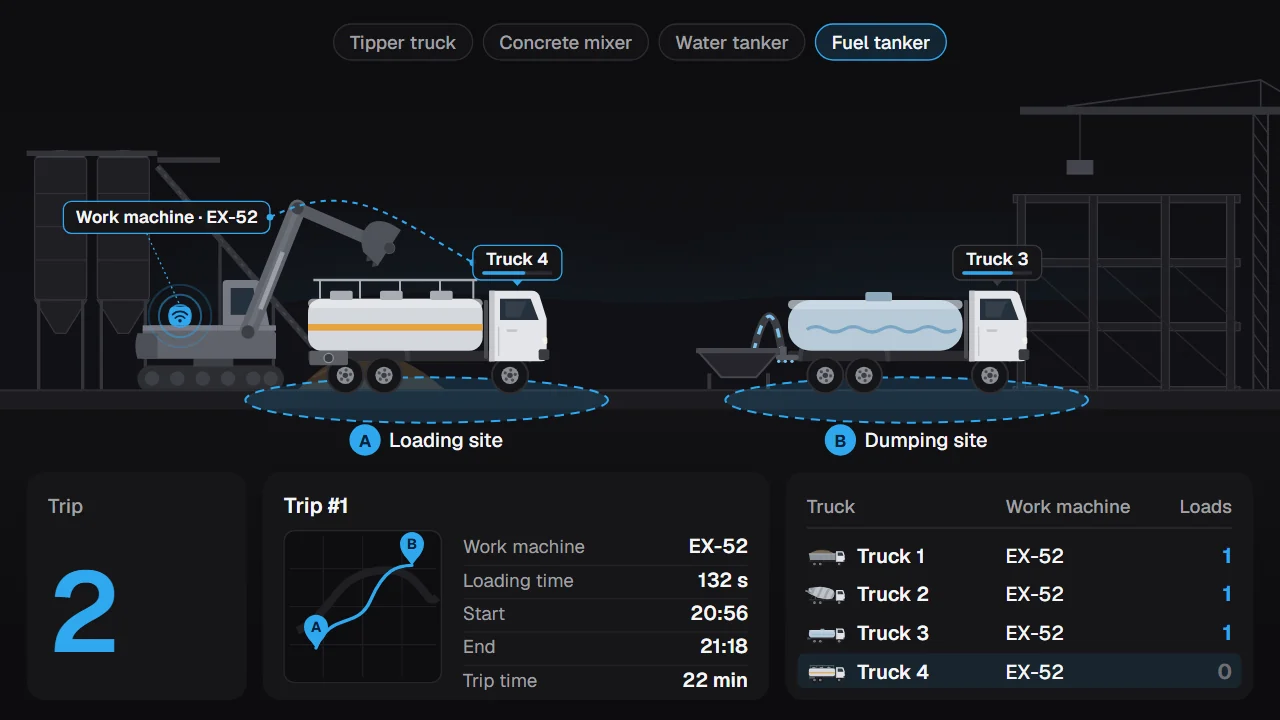
Animation: a vehicle is loaded at the loading site (A) and drives to the dumping site (B); trip counter, trip card and loads per truck

Trips counted by hand

The end-of-day trip list comes from the dispatch book or from what the driver reports. Any gap between the list and the work actually done goes unnoticed at the end of the day.

With MetadiagThe Trip Counting Module counts the trip by itself when the mixer leaves the pump zone. The trip card shows start and end times, trip duration and filling time, so no list is kept by hand.

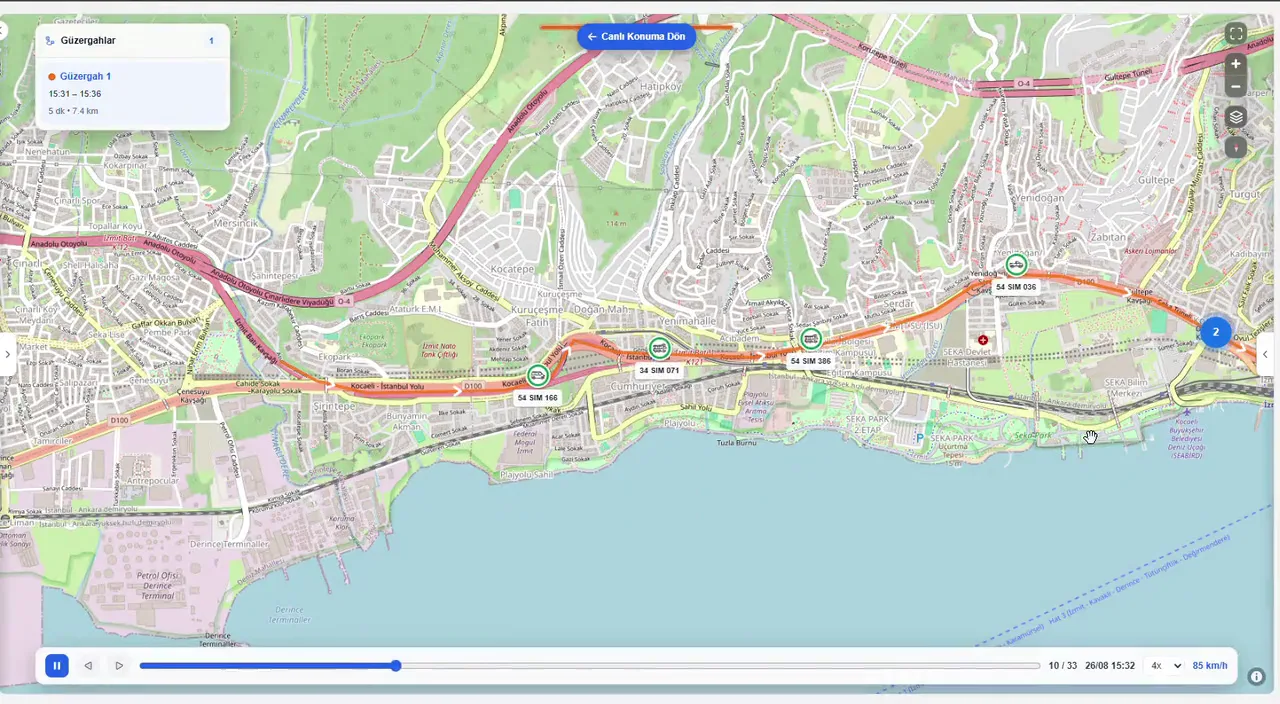
In MetaFMS, the selected route is replayed on the map; the list shows the time range, duration and distance

Plant-to-pump time is unknown

Specifications and contracts require concrete to be discharged within a set time, yet dispatch does not know how many minutes a trip really takes. The time is questioned only when a complaint comes in.

With MetadiagOn every trip, loading at the plant, discharge at the pump and total trip time are recorded separately. In one plant's record, a single trip on 2 April 2026 took 32 minutes, of which 8 were loading and 2 were discharge.

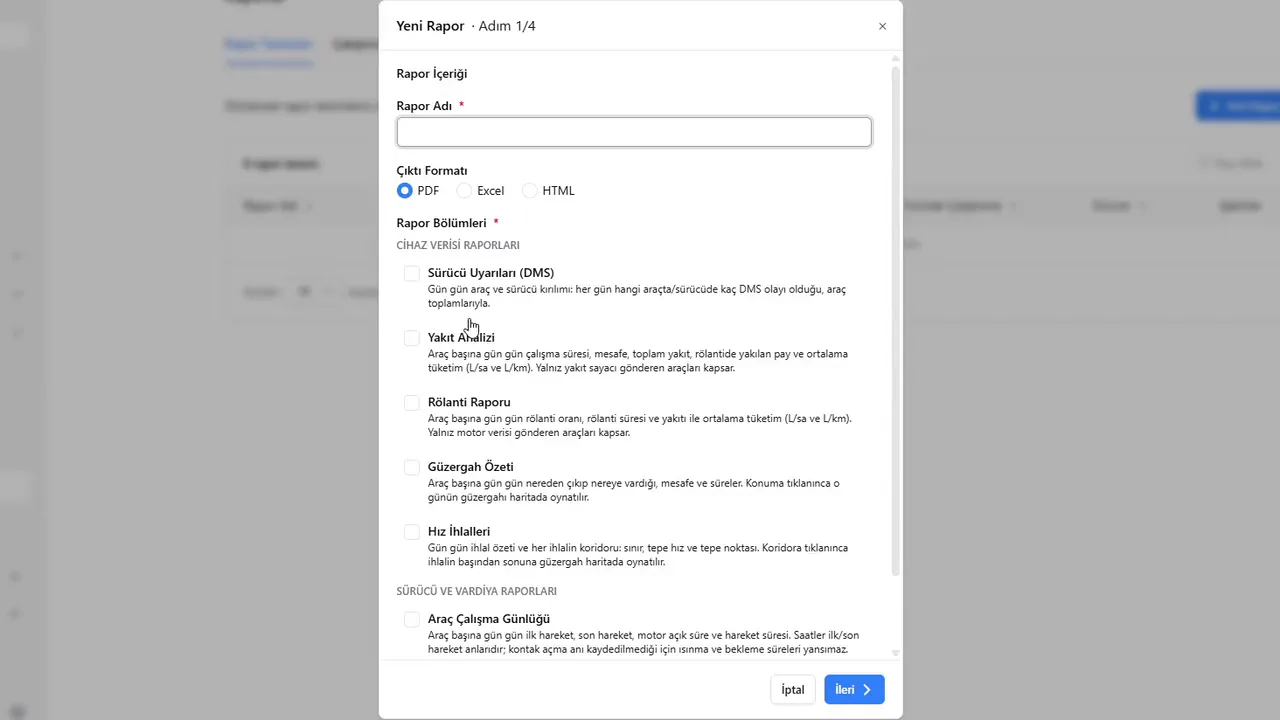
Creating a new report in MetaFMS: choosing the output format and report sections

The bottleneck is hidden

Are mixers queuing at the plant, held up on the road or waiting at the pump? When the steps are not measured separately, planning relies on impressions.

With MetadiagThe trip card shows loading, discharge and total trip time separately. Daily, weekly and monthly reports make it visible whether the bottleneck is at the plant, on the road or at the pump.

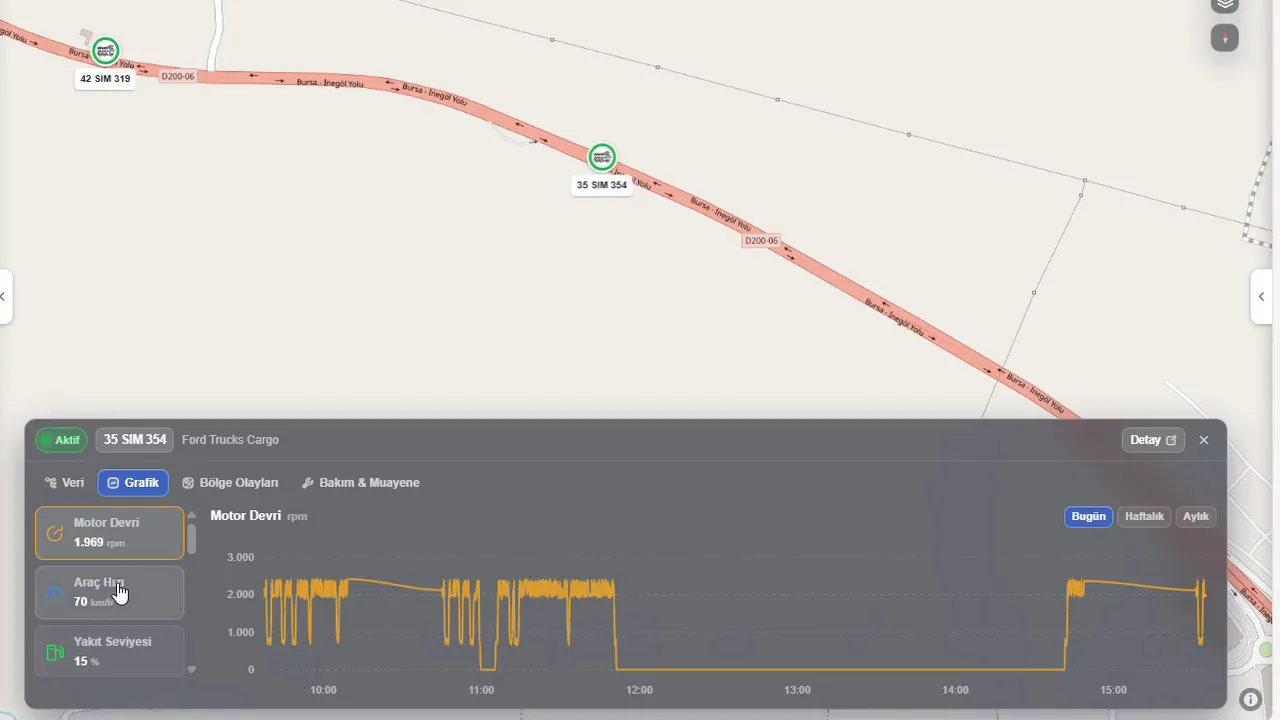
On the MetaFMS map: the daily engine speed chart and vehicle card for the selected vehicle

Fuel and load per trip sit in separate records

The fuel bill arrives as a fleet total; which trip or route burned more, and how much load was carried, cannot be seen in one table.

With MetadiagThe Trip Counting Module shows fuel and load per trip in the same table as the trip time. MetaTrack reports fuel and idle time for each vehicle. Coverage depends on the vehicle's CAN setup; tonnage is the vehicle's own data and has a margin of error.

Illustration: AI analysis detects the driver smoking in the cab

Driver behaviour in city traffic

A loaded mixer drives through city traffic to reach the site in time. Fatigue, phone use and speeding are noticed only after an incident.

With MetadiagMetaVision detects fatigue, distraction, phone use, smoking, speeding and seat belt violations, warns the driver with a voice alert and sends the event to MetaFMS. 4-channel 1080P recording is kept for up to 60 days with up to 512 GB of internal storage.

Tipper truck with its body raised unloading sand on uneven ground

Aggregate tippers overturning at the stockpile

Aggregate trucks raise their bodies on soft fill and sloping ramps at the plant stockpile. When a wheel sinks, a few degrees of side tilt can start a rollover.

With MetadiagMetaDamper measures side and front-to-rear slope continuously. When the default 5° side or 13° front-to-rear threshold is exceeded, it warns, stops the lift and lowers the body.

Frequently asked questions

Are QR-coded delivery notes and mixer tags mandatory in Türkiye?

Yes, for buildings under building inspection. Under the Turkish communiqué on fresh concrete sampling, since 30.11.2020 every mixer arriving at such a building carries a QR-coded concrete delivery note and a mixer tag that links its plate number to the producer; on site both are scanned and recorded. That system is the official record. The Trip Counting Module does not produce delivery notes and is not integrated with this system; it measures loading, discharge and total time for the same trip.

How soon must ready-mix be discharged?

Turkish law sets no general time; the limit comes from standards, specifications and contracts. For example, the concrete road pavement specification of KGM (General Directorate of Highways) requires concrete carried by truck mixer on concrete road works to be fully discharged no later than 90 minutes after the cement meets the water, and low-slump concrete to be discharged and placed no later than 45 minutes after mixing. The Trip Counting Module records the loading and discharge times of every trip; the moment the cement meets the water is read from the delivery note.

How does the Trip Counting Module count a trip?

A zone is defined for the plant and one for the pump. The mixer loads at the plant, drives to the pump and discharges; when it leaves the pump zone, the trip counts as complete and the trip number goes up by one. Trips, working time, fuel used and load carried are brought together in one table in MetaFMS. In one plant's record, 59 trips were recorded automatically between 10.03.2026 and 09.04.2026.

Is a tachograph mandatory on a concrete mixer?

In Türkiye, under Article 31 of the Road Traffic Law, goods vehicles with a maximum laden mass over 3,500 kg must have a tachograph; trucks such as concrete mixers were already subject to this rule before the 2026 amendment. A tachograph is a separate type-approved device and is not part of Metadiag's product range. The working time shown in the Trip Counting Module is the vehicle's working time; it does not replace the driver's driving and rest record.

Must aggregate trucks be covered?

Turkish law does not require a particular type of tarp; Article 65/1-h of the Road Traffic Law prohibits loading that can fall, spill or scatter without proper securing. See load securing under KTK 65/1-h. On open-body aggregate tippers, MetaControl covers the load from the cab. For the rollover risk when tipping at the stockpile, MetaDamper can be added to aggregate tippers.

Does the Trip Counting Module work with our existing tracking system?

The Trip Counting Module relies on the vehicle's location and CAN data and on MetaFMS's zone and trip features; the data appears in the MetaFMS panel. Which device it is installed with, and any integration with other systems, are agreed with our technical team before the offer.

Ready-mix concrete

Let's start with a few pilot vehicles in your fleet

Tell us how many vehicles you run and how you use them, and we will work out the right product set and installation plan with you.

Products of interest