What applies to public and municipal fleets?
There is no single regulation for public and municipal fleets in Türkiye. General traffic rules such as load securing and tachographs also apply to public vehicles, and municipal public transport has its own camera requirement. Three topics are specific to this sector: the municipality both runs vehicles and sets local rules through UKOME decisions; purchases are made through tender specifications; and the institution is the data controller for its employees' location and camera data. Below we summarise what each rule requires, whom it covers and its official source.
Mandatory (law) Securing the load
A vehicle may not be loaded, without proper lashing and securing, in a way that lets the load touch the road, fall, spill, scatter, leak, flow, slide, make noise, tip over or unbalance the vehicle. The law sets the outcome, not a method. The rule also applies to load-carrying vehicles of municipalities and public bodies.
- Applies to
- All vehicles carrying a load, including municipal and public tippers carrying soil, milled asphalt, sand, gravel and salt
- Dates
- In force since 27.02.2026
Source: 2918 sayılı Karayolları Trafik Kanunu md. 65/1-h (Turkish Road Traffic Law, Art. 65/1-h, as amended by Law 7574 Art. 18, Official Gazette 27.02.2026/33181)
Mandatory (law) Covering vehicles that carry excavation and construction waste
To prevent pollution during haulage, the vehicle body must be covered with suitable material, the vehicle may not be loaded above capacity and its wheels must be cleaned before it joins traffic. Carriers need a haulage permit from the municipality within its jurisdiction, or from the highest local civil authority outside it; construction and demolition waste trucks must be yellow and marked “İnşaat/Yıkıntı Atığı Taşıma Aracı”. The municipality is the body that issues and enforces this permit.
- Applies to
- Vehicles carrying excavation soil and construction or demolition waste, including municipal public-works trucks
- Dates
- In force
Source: Hafriyat Toprağı, İnşaat ve Yıkıntı Atıklarının Kontrolü Yönetmeliği md. 24–25 (Regulation on the Control of Excavation Soil and Construction and Demolition Waste, Arts. 24–25, Official Gazette 18.03.2004/25406)
By local decision Vehicle tracking and emergency button on vehicles operating under Laws 5216 and 5393 (by local decision)
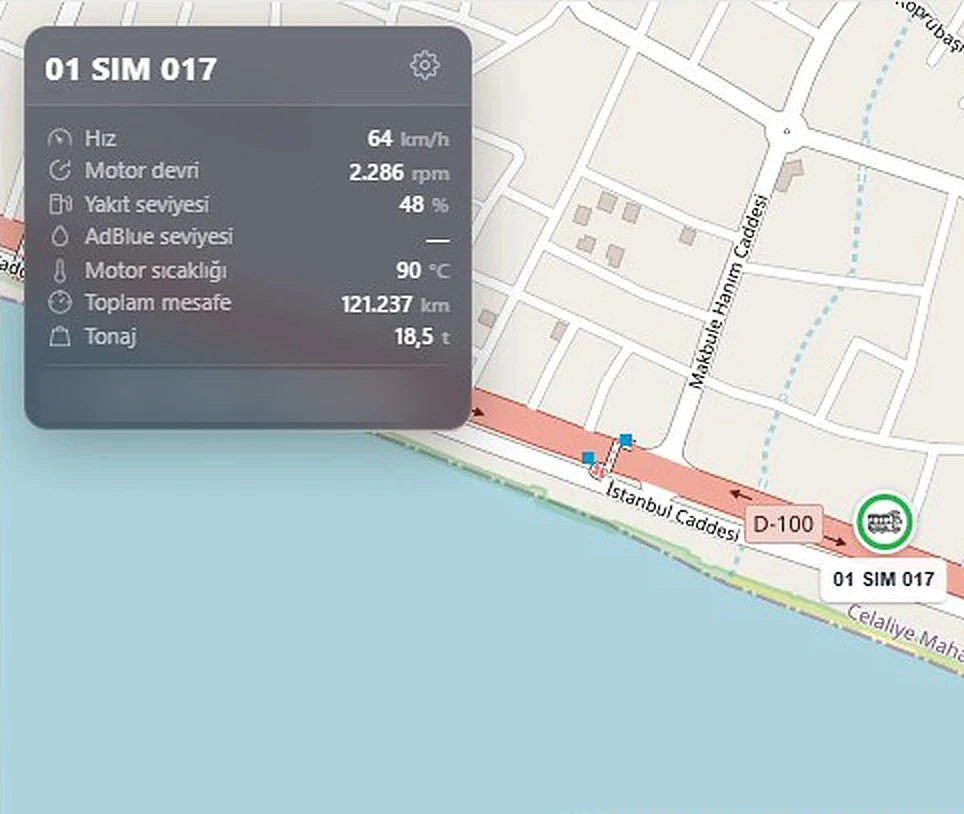
The vehicle tracking and emergency button requirement set for taxis and shared taxis may, where needed, be made mandatory by transport coordination centres (UKOME) or provincial traffic commissions for all or selected vehicles operating under Laws 5216 and 5393. The Ministry of Interior may also impose it nationwide. The fitting certificate is entered in the registration record. Whether a municipality's own service vehicles fall within this scope depends on the local decision.
- Applies to
- Vehicles operating under Laws 5216 and 5393 (those named in the local decision)
- Dates
- From the date set in the local decision
Source: Karayolları Trafik Yönetmeliği (Road Traffic Regulation), Additional Art. 4 (added in Official Gazette 29.11.2024/32737)
Mandatory (law) Cameras and recorders on municipal public transport
Vehicles must have a camera covering the interior (including the driver's seat) and the road ahead, plus a recorder that records while the vehicle is operating. Recordings are kept for at least one month and made available to the competent authorities; UKOME or the provincial traffic commission may require footage to be sent to an IP address.
- Applies to
- Public transport vehicles owned or authorised by municipalities, and M2 and M3 vehicles used in commercial passenger transport under Laws 4925, 5216 and 5393
- Dates
- New registrations: 30 days after publication on 19.08.2025. Existing vehicles: from the first inspection after 01.01.2026 (2023–2025 models), 01.01.2027 (2018–2022 models) and 01.01.2028 (2017 and older).
Source: Karayolları Trafik Yönetmeliği (Road Traffic Regulation), Schedule 1 (C) (Official Gazette 29.11.2024/32737) and Provisional Art. 12 (Official Gazette 19.08.2025/32991)
Mandatory (law) Tachograph (official vehicles included)
A tachograph is mandatory on vehicles used to carry goods with a maximum laden mass over 3,500 kg, and on vehicles with more than 17 seats including the driver used for passenger transport under Laws 5216, 5393 or 4925. A tachograph is a separate type-approved device and is not part of Metadiag's product range.
- Applies to
- Goods vehicles with a maximum laden mass over 3,500 kg, and passenger vehicles with more than 17 seats including the driver under Laws 5216, 5393 or 4925; vehicles built before Law 2918 entered into force and vehicles exempted by regulation because of the service they provide are excluded
- Dates
- In force since 27.02.2026; for trucks, tractor units and buses the tachograph was already mandatory before 2026 (Road Traffic Regulation Art. 64/b, Schedule 1). For other vehicles brought into scope by the new wording, it is not required until the first roadworthiness inspection after these dates, by model year: 2021 and later 31.12.2026; 2016–2020 31.12.2027; 2011–2015 31.12.2028; 1996–2010 31.12.2029; 1985–1995 31.12.2030. Within municipal and adjacent-area boundaries, for commercial passenger vehicles under Laws 5216 and 5393 and official vehicles used to carry goods or passengers, it is not required for vehicles registered for the first time for one year from 27.02.2026.
Outside the scope of Metadiag products
Source: 2918 sayılı Karayolları Trafik Kanunu md. 31 ve Geçici md. 27 (Turkish Road Traffic Law, Art. 31 and Provisional Art. 27, as amended by Law 7574 Arts. 6 and 34, Official Gazette 27.02.2026/33181)
Public tender specification 10 km/h limit while the body is raised (DMO specification)
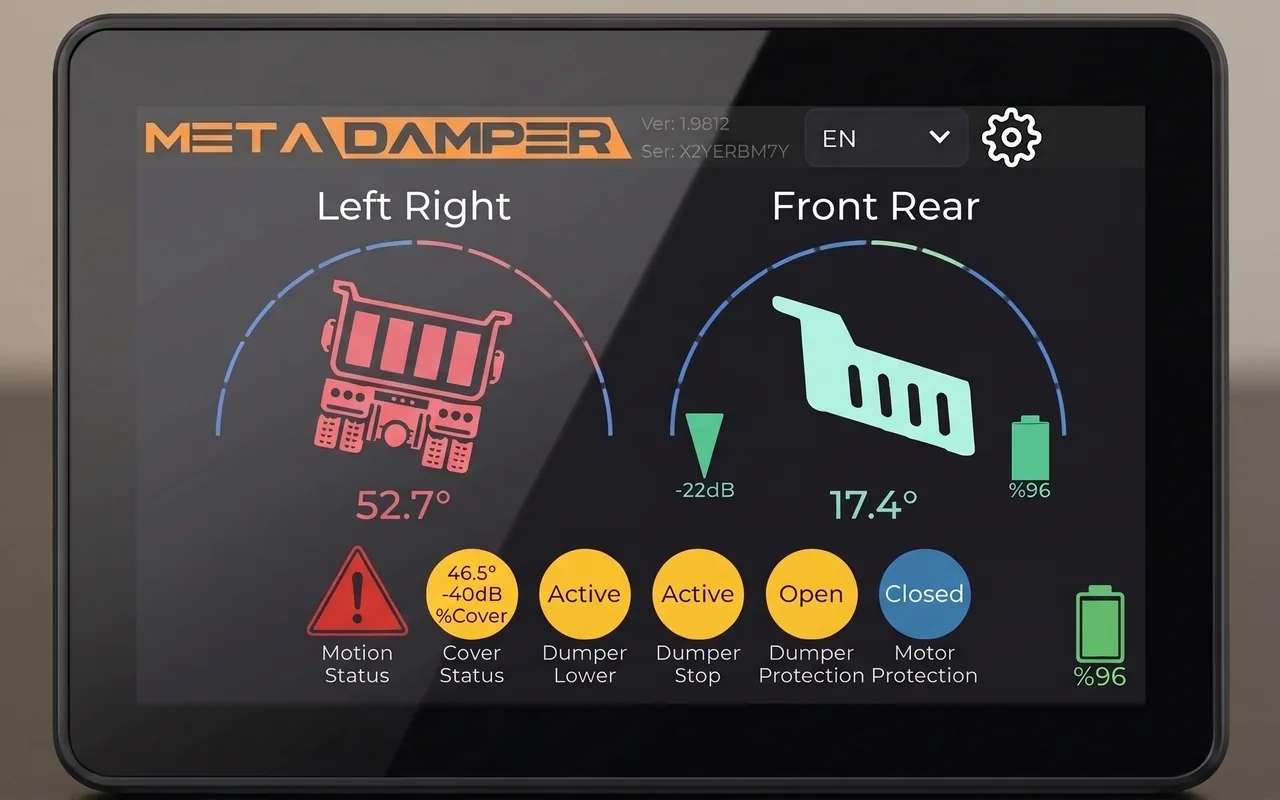
The specification asks for a system that limits road speed to 10 km/h while the body is not fully lowered, and a system that prevents the body from being raised while the vehicle is moving faster than 10 km/h. MetaDamper's motion control (the 4.3″ display or the Motion Control Module) is built for the part that stops the body rising while the vehicle is moving; limiting road speed while the body is raised is not a product function.
- Applies to
- 6–18 m³ tipper trucks bought through DMO (State Supply Office); the clause binds only purchases made through DMO
- Dates
- Specification dated 25.07.2017; confirm the current version with DMO
Source: Devlet Malzeme Ofisi Damperli Kamyon Teknik Şartnamesi (DMO tipper truck technical specification A.24.d/25.07.2017), Art. 1.2.4.1
Public tender specification Domestic-goods price advantage and R&D product certificate in public tenders
In goods tenders, bidders offering domestic goods may be given a price advantage of up to 15%; the 15% advantage is mandatory for medium and high-tech goods on the Ministry's list and for domestic software products. Certificates of products resulting from R&D projects can be used as documents showing work experience for five years from the date the product was placed on the market (Art. 10/f). This is an advantage for the bidder, not a vehicle duty. MetaCooler's hardware domestic-goods certificate application is in progress.
- Applies to
- Tenders under Turkish Public Procurement Law No. 4734
- Dates
- In force
Source: 4734 sayılı Kamu İhale Kanunu md. 10/f ve 63/1-c (Turkish Public Procurement Law, Arts. 10/f and 63/1-c, as amended by Law 7033)
Public tender specification Cloud fleet panel and information security in public bodies
Under Presidential Circular 2019/12, data of Turkish public bodies is not stored in cloud storage services other than the bodies' own private systems or domestic providers under their control. The measures also include an undertaking that purchased software and hardware contain no back door, and security testing before use. For a cloud-based fleet panel, where data is hosted and how it is tested may therefore come up at the tender stage.
- Applies to
- Public bodies buying cloud-based software and services
- Dates
- In force since 06.07.2019
Outside the scope of Metadiag products
Source: Bilgi ve İletişim Güvenliği Tedbirleri (Information and Communication Security Measures), Presidential Circular 2019/12 (Official Gazette 06.07.2019/30823)
Mandatory (law) Data protection for location and camera data: the institution as controller
For vehicle tracking and camera data, the institution is the data controller. Personal data is processed for specified, explicit and legitimate purposes, in a relevant, limited and proportionate way, and kept only as long as necessary. The people concerned are informed, and the technical and organisational measures needed to keep the data secure are taken.
- Applies to
- Public bodies and municipalities that process location or camera data of employees and citizens
- Dates
- In force
Source: 6698 sayılı Kişisel Verilerin Korunması Kanunu (Turkish Personal Data Protection Law), Arts. 4, 5, 10 and 12 (Official Gazette 07.04.2016/29677)